Lean Hospitals AI Coach — Available On Demand
Practical Lean coaching for healthcare leaders, grounded in the book.
One request before you start: do not ask it a test question. Bring something you are actually stuck on. It is built for real work and does not perform well as a party trick.
Founding members get $49/year, and your rate stays the same for as long as you stay — limited to the first 50 subscribers. Subscribe now or try it free for 48 hours.
A Second Set of Eyes on Thinking You Have Already Done
Most people describe AI as something that gives them an answer. The people who get the most out of this one use it the other way around. They think a problem through first, or draft the memo, and then bring it here to find out what they missed.
This is not a cheaper version of consulting. It is a different thing entirely — a thinking partner you can use at 11pm before a difficult conversation, or Monday morning before a team meeting, without scheduling anything or managing a relationship.
It helps you think more clearly before you act. That is not a substitute for expertise. It is the thing most leaders say they need most and have least access to.
Grounded in Real Healthcare Experience
This coach reflects the principles, leadership behaviors, and practical experience of Mark Graban — author of Lean Hospitals and trusted advisor to healthcare organizations worldwide.
It emphasizes:
- Respect for people
- Psychological safety
- Practical problem solving
- Learning from mistakes
- Systems thinking instead of blame
- Sustainable improvement
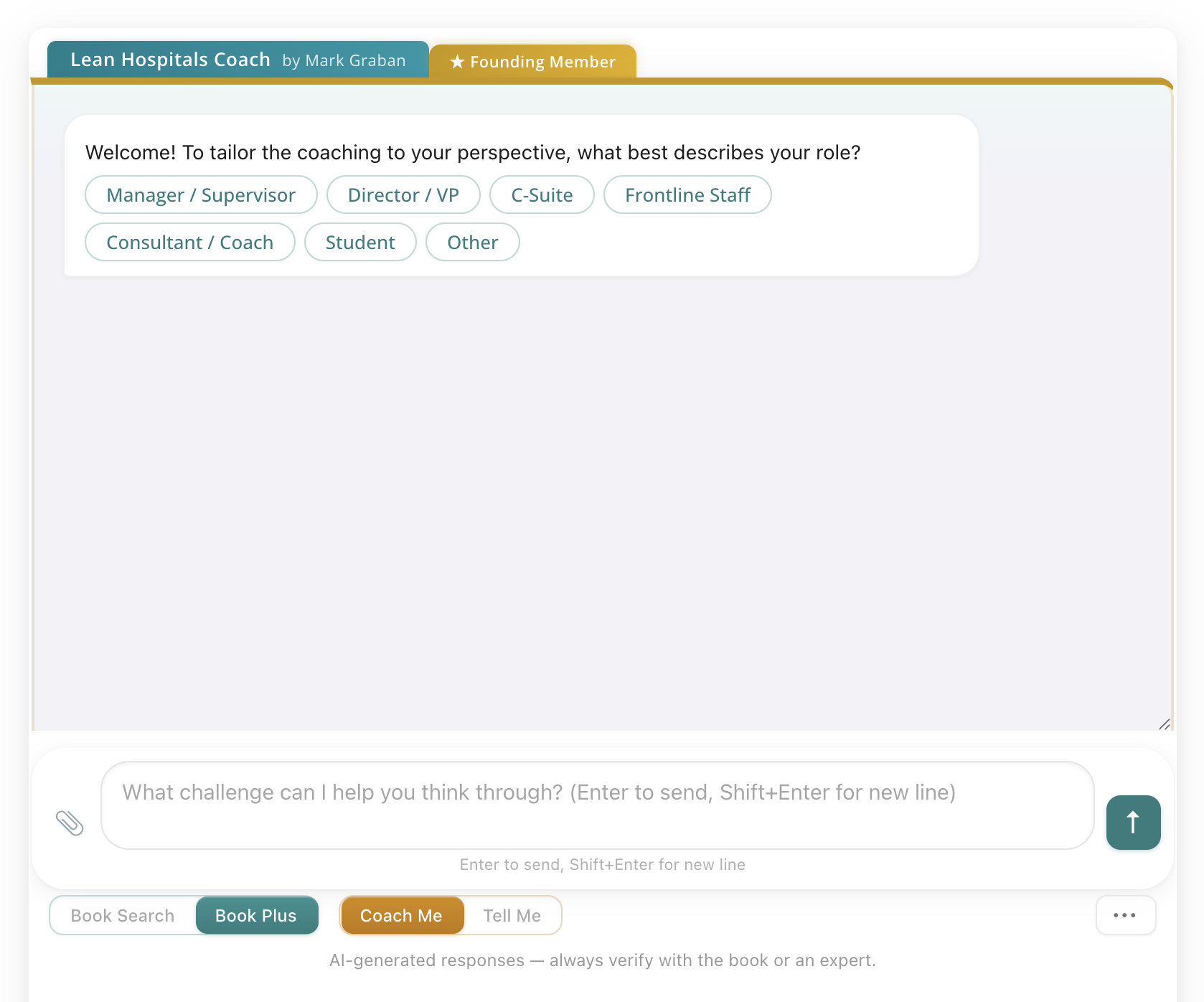
How the Coach Works
Two independent settings you can combine in any way: where it looks for answers, and how it responds. Plus structured coaching modes when you want a method rather than a conversation.
Where It Looks
Book Search — Answers grounded directly in Lean Hospitals. The coach searches the book first and tells you what it found. Best for topics the book covers directly: daily huddles, leader standard work, visual management, A3 thinking, error-proofing, and more.
Book Plus — Everything in the book, plus broader Lean and improvement knowledge. The coach still references Lean Hospitals when relevant, but also draws from TPS, cross-industry examples, and the wider world of continuous improvement. Best when you want perspectives beyond any single book.
How It Responds
Tell Me — Direct answers. Leads with the point, then supporting context. Best when you need information quickly or want something clear to share with your team.
Coach Me — A thinking partner, not an answer machine. Asks questions one at a time, suggests small experiments, and helps you work through real challenges rather than handing you a checklist.
Structured Coaching Modes
When you want a method rather than an open conversation, three modes run a recognized improvement approach with you, step by step.
Kata Mode — Works through an Improvement Kata cycle: where you are now, where you want to be, what obstacle is in the way, and what experiment comes next.
A3 Mode — Takes a problem through A3 thinking, from background and current condition to root cause, countermeasures, and follow-up.
5 Whys Mode — Keeps asking until you get past the first plausible cause. Most 5 Whys exercises stop at three and land on human error. This one does not let you.
Guided Packs
Sequenced sets of prompts for working through a topic in order, rather than figuring out what to ask next.
Not sure which combination to use? Start anywhere. Switch anytime, even mid-conversation. There is no wrong entry point.
This Is Not Generic AI Advice — Here Is the Difference
Ask most AI tools “Should we use Lean to reduce costs in our department?” and they will say yes and give you a list.
This coach will push back. Cost reduction is a likely outcome when you improve quality, flow, and safety — but leading with cost as the goal often undermines engagement and misses the point entirely. That reframe comes directly from Chapter 1 of Lean Hospitals: “Good quality costs less.”
That is not a guardrail bolted on. It reflects how the tool is built throughout.
What it will not do:
- Write your A3, your charter, or your presentation. It will work through them with you.
- Recommend Lean as a headcount reduction method, however the question is phrased.
- Accept patient information. If you paste any, it redirects you and the conversation is excluded from saved history.
- Pretend to know your gemba. If you have not gone and looked, it will say so.
Book Plus Is Curated, Not Open-Ended
There is a lot of misinformation about Lean — Lean reduced to cost-cutting, “Lean Six Sigma” treated as a single methodology, belt certifications presented as competence, improvement framed as something done to workers rather than with them. Mark Graban has built guardrails into this coach so that every response stays consistent with the principles in Lean Hospitals, The Mistakes That Make Us, Measures of Success, and his broader body of work.
The coach is guided to:
- Trace Lean to its roots in the Toyota Production System, not treat it as a generic buzzword
- Frame cost reduction as a result of good Lean work, never the primary goal
- Emphasize Respect for People, psychological safety, and systems thinking
- Treat mistakes as learning opportunities, not moral failings
- Encourage Process Behavior Charts and run charts over red-yellow-green scorecards
- Frame improvement as hypothesis-driven (PDSA), not top-down rollout
- Distinguish between kaizen events and daily continuous improvement
- Use careful, human-centered language — no “driving compliance” or “deploying Lean”
It is also guided to push back on common distortions, including:
- “Lean is for speed, Six Sigma is for quality” (a false trade-off)
- Lean as primarily a cost-cutting or headcount-reduction program
- Blaming workers for problems caused by the system
- “Do more with less” without redesigning work
- Measuring success by number of events completed
Think of Book Plus mode as an expansion of the book’s ideas into a wider landscape — curated to stay philosophically consistent, not just technically accurate.
Who This Is For
Leaders accountable for results:
- Hospital executives
- Clinical leaders
- Quality and safety professionals
- Improvement directors
- Frontline managers
If you are expected to solve problems, align teams, and deliver better outcomes — this tool is built for you. Even if you do not have formal improvement training.
The most common use is not learning Lean. It is checking a decision before you commit to it.
Privacy and Patient Information
This is an improvement coaching tool, not a clinical system. It does not need patient data and is built to prevent it from being shared.
Three layers of protection work together: client-side pattern detection blocks likely PHI before it leaves your browser; the AI model is instructed to flag and redirect if patient-identifying information appears; and any conversation that triggers a PHI warning is automatically excluded from saved history.
Responses are generated using Anthropic’s Claude API. Document retrieval uses the OpenAI API. Neither provider trains on inputs submitted through their standard APIs, and no Business Associate Agreement is in place with either. This is not a HIPAA-covered service.
Use it the way you would talk to an outside coach: discuss processes, systems, metrics, and challenges — not specific patients. The tool reinforces that boundary, but good practice starts with you.
For full details, see the Help page.
Join as a Founding Member — or Try It Free First
Founding members get $49/year, and your rate stays the same for as long as you stay — limited to the first 50 subscribers. Your feedback shapes what gets built next.
Not ready to commit? Try it free for 48 hours — full access, no credit card, no automatic charges.
One request either way: do not ask it a test question. Bring something you are actually stuck on. It is built for real work and does not perform well as a party trick.
Frequently Asked Questions
A coaching tool for healthcare leaders and improvement practitioners, grounded in Lean Hospitals by Mark Graban. It is not a general-purpose AI — every response stays consistent with the principles in the book and Mark’s broader body of work.
ChatGPT will answer almost any question about Lean without pushback. This coach has guardrails — it will reframe cost-cutting framing, push back on “resistance to change” language, and stay consistent with what good Lean thinking actually looks like. It also adapts to your role and remembers context from past conversations.
It also runs structured methods with you: Kata, A3, and 5 Whys modes work through a problem one step at a time rather than producing a summary.
Yes. Book Search mode draws directly from the text. Book Plus mode extends into broader Lean knowledge while staying philosophically consistent with the book’s principles.
Kata Mode walks an Improvement Kata cycle with you. A3 Mode works a problem through A3 thinking. 5 Whys Mode keeps asking until you get past the first plausible cause. Each one runs a real method rather than summarizing it.
This is a process improvement tool, not a clinical system. Do not share patient-identifying information. The tool has three layers of protection to prevent PHI from being submitted or stored. Responses are generated using Anthropic’s Claude API and document retrieval uses the OpenAI API; neither trains on inputs through their standard APIs, and there is no Business Associate Agreement with either. It is not a HIPAA-covered service. Use it the way you would talk to an outside coach: discuss processes, systems, and challenges, not specific patients. See the Help page for full details.
Yes. The interface is mobile-responsive.
Mark Graban — author of Lean Hospitals, The Mistakes That Make Us, and Measures of Success, and a consultant and coach to healthcare organizations for over 30 years.
Yes, from your billing page, anytime. Cancelling stops the renewal and you keep access through the end of the period you already paid for. No email required, no retention call.